Dutch Yoga
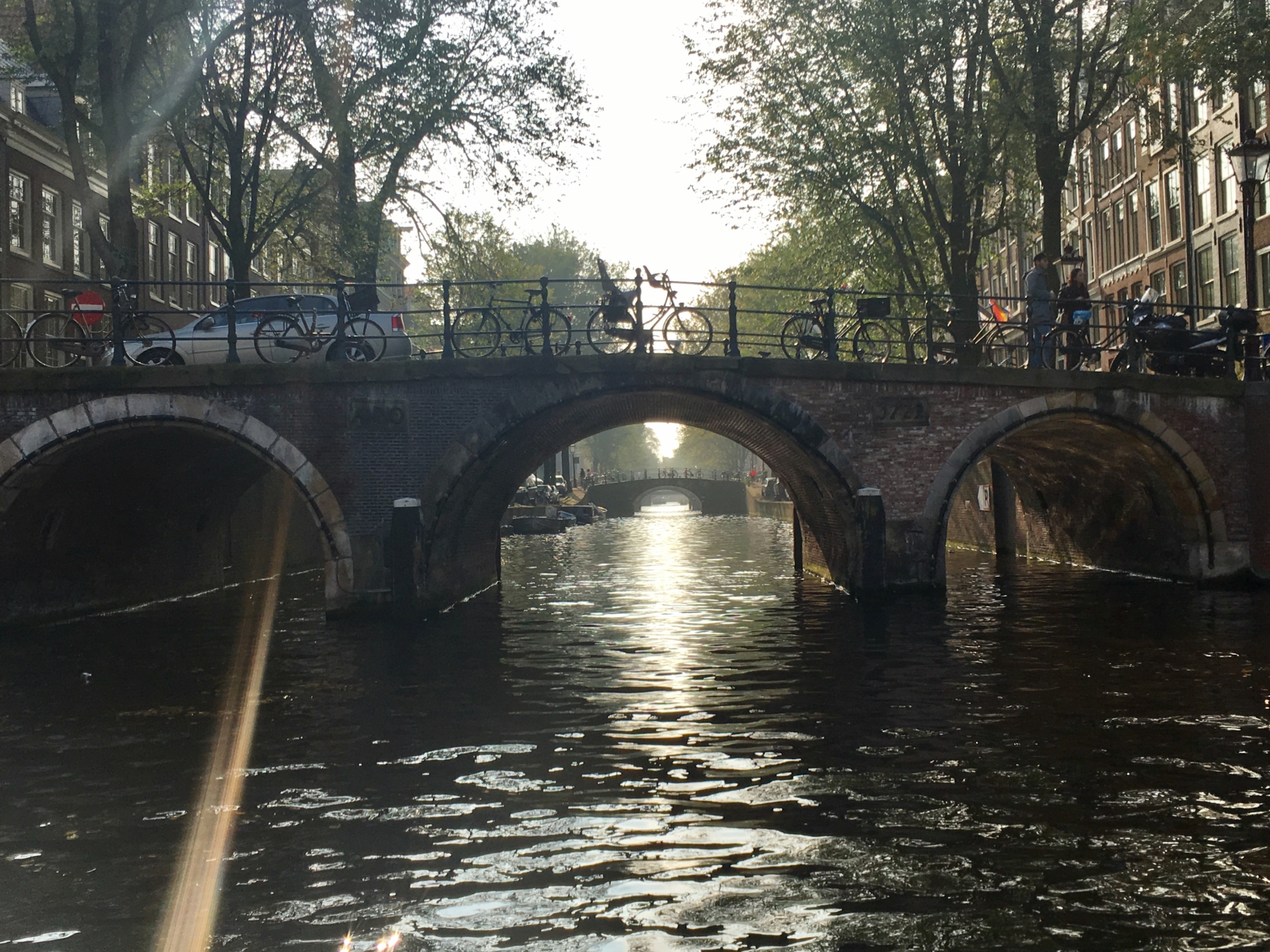
With love for the enduring canals of Amsterdam, and for the joy of practicing yoga anywhere in the world.
My eyes float open a generous three minutes before the ringing alarm. I love when this happens! Rising before 8:00 AM is a chore for me, but such is my commitment to yoga. It must be the power of Shavasana. It helps too when your gracious Airbnb host comps a class for you at a health club he just happens to own, which, by the way, is aptly named “Fit for Free!” I linger a moment, thinking and stretching. A big yawn erupts. I thank God for the day, my bed for a good night’s sleep, and…oh rats! – now my alarm really is ringing! Reaching…got it! Like a wave, my hubs rolls over and I spill out of bed.
I’ve allowed plenty of time for my contacts (a huge thank you for those, God!), a quick Nespresso, and for any of life’s little morning glitches. Walking out the door ahead of schedule, I’m feeling confident in navigating the Google-mapped 32-minute trek to my first Dutch yoga class.
It’s a gray but mild morning. The walk along the endless canals is quiet and beautiful. I breath in the cool morning air. There’s no smell or sign of the previous night’s revelers, nor the bright-eyed bushy tailers. It seems that Amsterdam is a late riser, like me. I fall for this city even more.
In just 24 minutes, I reach my destination. Stepping through the revolving door, I spin into what feels like a scene from 1977’s Pumping Iron. The largish space is all concrete and metal. Bulky guys with pained expressions glance up from their reps. One of them steps behind the desk, and asks, “yes?” His friendly biceps, along with the yellow bandana around his forehead, soften my impression that he’d rather not be here. I smile, and I give him my name, along with the name of my very close, personal friend, Gerald – you know, the owner of this charitable establishment? After some paper-shuffling, he reveals no prior knowledge of Gerald – nor me, not surprisingly –but says I’m welcomed to take the yoga class, and wouldn’t you know? – that it’s free! I expect the usual paperwork, but instead am offered a tour of the place. My eyes widen. Feeling every bit a VIP now, I sense my eyelashes flutter a little, and happily agree.
Passing through the monochromatic space, it dawns on me that this is my first time practicing yoga at a gym. Hmmmm. Oh well, I guess it’s comforting losing my gym-yoga virginity to a place filled with muscly men. We pass the group classroom, and I think back to my invitation to come here. Gerald said that the teacher’s name is Alexandra, a German-born woman who has a reputation for being “strict.” My experiences with yoga teachers who smile a lot, and even hug me after class give way to black and white images of stern women in yoga pants wielding sticks. I sneak a peak through the windowed door to see if this person who’s made me curious and slightly scared is in there. Nope, it’s a spin class. The tour ends, and thanking my guide, I pop into the ladies locker room to wash my hands, pull up my hair, and gather my courage.
Pausing at the door of the House of Discipline, the other four yoga students and I acknowledge and smile to each other in a respectful, Namasté-like way – then enter the space. I grab a hanging mat and a block, and lay them down, creating a second row for the purposes of inconspicuous observation. My mat has seen better days, and has the smudged foot and handprints of many a Downward-Facing Dog. Thankfully, a spray-bottle of cleansing solution and a roll of paper towels across the room catches my eye and has me feeling more hopeful. I give my mat a swipe, then sit down on my block.
Just breathing and settling in, I notice that it’s showtime, and there’s no teacher. How strict can she be? – arriving late for her own class, for Pete’s sake!? A minute later, she emerges. Her red, wavy hair is braided and pulled up and away from her expressionless face. She wears a pretty shawl, and manages to look good in those billowy pants that yogis wear. She uncloaks, and finds her place in Sukhasana, or Easy pose, on her very clean mat. The classroom is silent; expecting a story of the dog that got out, or the alarm that failed, but instead Alexandra says, (in English, thankfully), “I am taking a silent day today; there will be no small talk.” Boom. And that’s that. The gauntlet makes a loud thud. She is definitely going to be strict.
We begin with our breath. We need it – everyone’s wondering how this is going to work with a mute teacher. “Six cycles of breathing,” she whispers. I breath and think of my western yoga studios again – full of hugs, smiles, and sometimes a little too much talking – but a silent class? Alexandra then says to find Balasana, for another six cycles of breath. I’m bored. Nevertheless, the class patiently progresses, and we’re led – mostly by example, through a kneeling Sun Salutation. Gradually, the sound of Ujayi breathing awakens in the room. The energy is shifting from nervous to receptive; the rhythm of our practice is like a rising kite, our breath the string linking us to ourselves and each other. I become aware that the scarcity of Alexandra’s cues, with her repetitive postures, is bringing focus and certainty to our intentions. I steal a glance from my second row to see relaxed and flowing forms, then hear a soft, “Downward Dog,” – for, you guessed it, “six cycles more…”
From there, we practice a nice complement of traditional standing postures, then finish that sequence with Vrikshasana, i.e., Tree Pose. Our quiet teacher is eyeing everyone with hawk-like attention, but doesn’t offer encouragement, adjustments, or verbal corrections – yet, everyone is just fine; thriving, in fact. Hmmmm….noted. Then it’s down on the mat for supine stretches, and a totally silent Shavasana.
Minutes later – who knows how many?(The power of Shavasana), we rise from our places with soft eyes to seal our practice with that small word that says so much. “Namasté,” we breath out; and before our bowed heads look up, Alexandra is gathering her things and is practically out of the door. Feeling a bit puzzled, and sort of craving my hug, I watch her go. In that moment of longing, I realize that nothing is missing, really. With admiration for our precise teacher, we all silently rise and follow her lead.
I wave a cheery good-bye to the guys doing hammer curls, who can’t help but grin at my goofiness, then head back along Prinsengraght to our Airbnb to meet Tommy for breakfast.
The once slumbering streets have awakened. Shopkeepers are setting up signs and bistro sets for their patrons. They seem so happy and open to the day’s possibilities. I wonder if they can they see my very full heart bursting from my chest? Thinking back to my morning – what a gift Alexandra turned out to be. She taught me the power of restraint in my teaching; less can definitely be more. And best of all, my silent teacher reminded me what I love most about yoga –that familiarity of coming home to yourself when you step on the mat. No matter where home is, it’s on my yoga mat, in my class, with my teacher; geographically-free, multi-cultural, and boundless. My smile brightens to the friendly Amsterdamers when our eyes meet because I see that my Dutch yoga class has been, gloriously, anything but Dutch.